9 minute readModality deep-divePublished May 6, 2026
Sound healing sits at an awkward intersection. Ancient traditions take it seriously. Modern science partially confirms it. Instagram practitioners make claims that go well beyond either.
On this page
Sound healing exists at an awkward intersection.
Ancient traditions take it seriously. Modern science partially confirms it. Instagram practitioners, often with three months of training and a set of crystal bowls, make claims that go well beyond either.
The result is a field where a sound bath in a Himalayan monastery and a sound bath in a Soho yoga studio are both called the same thing, and where serious music therapists working in clinical settings publish in the same Google search results as influencers selling 528 Hz "DNA repair" downloads. Untangling this matters, because the practice itself is real and useful, and the inflated claims around it can put a thoughtful person off something that would actually help them.
This piece sorts the layers. What sound healing is, what it does, what the evidence supports, and how to read the difference between a serious practitioner and a marketing one.
What sound healing actually is
The working definition is simple: the use of musical instruments and the human voice to influence physiological and psychological states. Past that, the field splits cleanly along two lineages that are almost never named separately.
The first lineage is ceremonial and traditional. Tibetan bowl practice in Himalayan Buddhist contexts. Aboriginal Australian didgeridoo healing. Indian raga as therapeutic medicine. Indigenous drum ceremonies across the Americas. African ritual percussion. These are religious or culturally specific practices with thousands of years of context. They are not portable to a Saturday afternoon class without losing most of what makes them what they are.
The second lineage is modern and Western. It includes music therapy as a clinical discipline (a regulated profession with master's-degree credentialing in many countries), sound therapy as practised in spa and wellness contexts, and the sound bath culture that emerged in California and London in the 1970s and 1980s and exploded after 2015.
These are not the same thing. Calling them by the same name produces most of the confusion in this field. A serious sound practitioner is clear about which lineage they trained in.
The instruments and what they do
Singing bowls, Himalayan and crystal
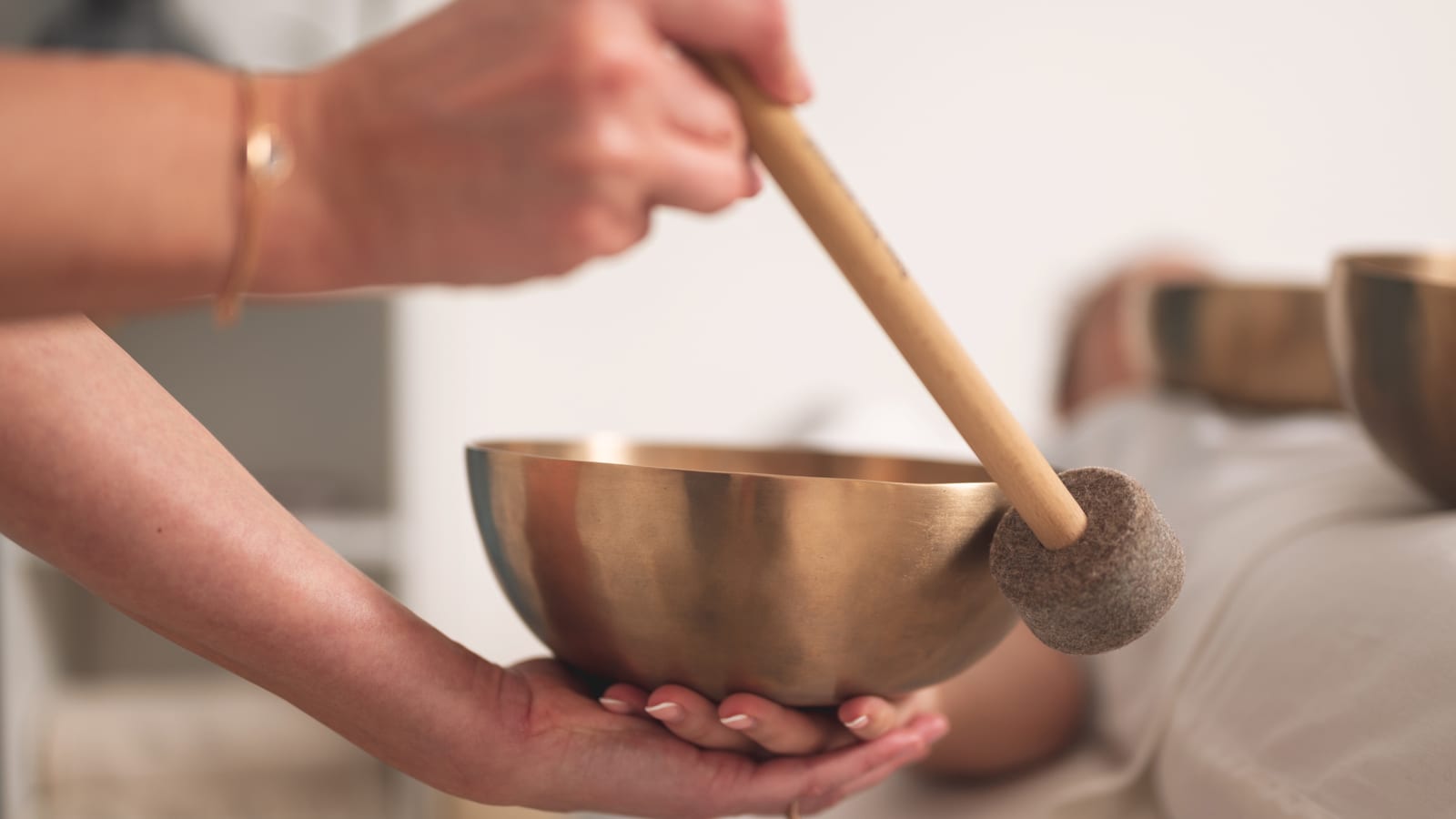
Himalayan or metal singing bowls are hand-hammered alloys, traditionally a seven-metal blend, made across the Himalayan region for centuries. The tones are complex, with multiple overtones, and decay relatively quickly. The lineage of the instrument is genuinely old, though the bowls' specific use in modern Western sound baths is a twentieth-century adaptation.
Crystal singing bowls are machined quartz, an American innovation from the 1980s onward. The tones are pure, sustained, and visually striking. The instruments produce strong vibrational sensation that many recipients feel in the body directly. Whatever the bowl is made of, the instrument's effect comes from sustained tone plus full-body vibration plus a quiet held environment.
Gongs
A gong is a deeply harmonic instrument that produces a sustained, complex wash of sound when struck softly and played in slow waves. In a sound bath context, gongs are usually placed at one end of the room and played as the centrepiece. A skilled gong player can produce minutes of continuous, evolving sound from a single instrument. The acoustic experience is immersive in a way that bowls are not.
Tuning forks
Tuning forks are precision instruments calibrated to specific frequencies, often 128 Hz for body work or various weighted forks for direct skin contact. They are used in practitioner-led, one-to-one sessions rather than group sound baths. The premise is that targeted frequencies, applied to the body or held near it, produce specific physiological effects. The evidence is uneven, but the practice is intimate and the calibrated nature of the instrument distinguishes it from the more atmospheric work of bowls and gongs.
Drums
Rhythmic drumming is the oldest of these practices and crosses essentially every traditional culture. The mechanism is rhythmic entrainment: the body's autonomic systems begin to follow the beat, slowing or quickening with the drum. Shamanic drum journeying is a structured practice within several Indigenous and contemporary lineages.
The voice
Vocal sound healing, including chanting, toning, mantra practice, and overtone singing, is possibly the oldest form. It appears in Vedic Sanskrit chanting, in Christian monastic plainsong, in Tibetan throat singing, in Sufi zikr. The modern Western re-emergence of vocal toning has roots in both yoga traditions and twentieth-century experimental music. Like Reiki, vocal toning is a non-touch modality, and the ones who become skilled at it usually come from years of disciplined practice rather than weekend training.
The frequency question, what's real and what's marketed
This is the part of the field most in need of careful sorting.
The Solfeggio frequency claims, the now-famous list of 396 Hz, 417 Hz, 528 Hz, 639 Hz, 741 Hz, 852 Hz, and 963 Hz, were popularised in the 1990s by Joseph Puleo, who derived them from his interpretation of a medieval hymn to Saint John the Baptist. The framing of these specific numbers as "ancient sacred frequencies" with specific healing properties is not historically supported. The medieval Guidonian hexachord, the actual musical system Puleo drew on, used a different tonal logic, and the numbers themselves come from a numerological method applied later.
The 528 Hz "DNA repair" claim has not been demonstrated under controlled conditions. Specific frequencies do not "repair DNA" in any reproducible sense, and the studies sometimes cited in support of the claim either do not exist or do not say what they are summarised as saying.
The 432 Hz versus 440 Hz debate is a cultural and historical one, not a clinical one. Western orchestras have used multiple tuning standards across centuries; 440 Hz became the international standard relatively recently. There is no measurable physiological superiority of either pitch in controlled study.
What is real, and well-demonstrated, is that low-frequency vibration affects mood, alertness, and the autonomic nervous system. Brainwave entrainment through binaural beats has some evidence for relaxation and focus support, though the effect sizes are modest. Music therapy, the clinical discipline, has substantial evidence for reducing anxiety in clinical settings, modulating pain perception, and supporting markers of depression. None of this requires the Solfeggio numerology to be true.
What a sound bath actually feels like
Most sound baths run sixty to ninety minutes. The room is set up with mats, bolsters, and blankets; participants lie down, sometimes in concentric arcs around the practitioner's instrument array. The session usually opens with a short grounding (often a few minutes of guided breath), moves into the sound itself, and closes with a few minutes of integration.
What participants commonly report: deep physical relaxation, often deeper than from any conscious technique. Occasional emotional release, sometimes tears, often without identifiable cause. Drift into hypnagogia, the sleep-adjacent state. Vivid imagery for some, complete blankness for others. A persistent sense of softening that lasts hours after the session ends.
What some participants report: boredom, mild discomfort with sustained tones, a sense of being trapped on the floor for ninety minutes. These are legitimate responses. The practice is not for everyone, and a single session is not enough information to decide. Two or three sessions with different practitioners, if the first one didn't fit, gives better data than abandoning the modality on one experience.
The mechanism of why sound baths work, when they work, overlaps significantly with breathwork. Both practices work on the autonomic nervous system through extended parasympathetic activation. Both rely on a held, safe environment, on physical stillness, and on a practitioner whose presence is the actual instrument the room responds to. The instruments matter; the practitioner matters more.
What the evidence actually shows
Music therapy, the clinical discipline, has the strongest evidence base of any practice on this page. Multiple meta-analyses support its efficacy in reducing anxiety in pre-surgical and oncology contexts, in modulating pain perception in chronic-pain populations, and in supporting depression-related outcomes when offered alongside standard care. This is the high-evidence corner of the field.
Sound healing as practised in the wellness space has less rigorous study but consistent self-reported outcomes: stress reduction, improved sleep, a sense of release, sometimes a sense of being "moved" without being able to articulate why. Smaller controlled studies on specific applications (singing bowl meditation for tension reduction, for instance) show modest, replicable effects.
The gap between well-studied and well-experienced is where the practice has always lived.
The honest take is this: parasympathetic activation, the enforced stillness of lying on a mat for ninety minutes, the safe holding environment, and the deep relaxation that follows from being fully attended to without being touched, are the active ingredients. They are real. They are reproducible. They do not require the frequency mythology to do their work.
Choosing a sound practitioner
There is no single accreditation for sound healing in most jurisdictions. What can be evaluated is mentorship lineage (where did the practitioner train, and with whom), hours of practice (how many group sessions have they actually held), and instrument-specific training (a Himalayan bowl master in Nepal trains for years; a weekend crystal-bowl certificate is not the same).
Watch for inflated claims. "Cellular healing," "DNA repair," and specific disease cures are signals of a marketing-trained practitioner, not a craft-trained one. Watch for practitioner ego; sound healing is a holding practice, not a performance, and a player who treats the session as their show is not running a sound bath, they are running a recital.
Watch for environmental basics. Is the room actually quiet? Are the mats clean? Is the practitioner punctual, prepared, calm? These small things predict the quality of the work better than any marketing copy.
The same vetting questions apply across modalities. Our piece on what spiritual concierge actually means covers the broader framework of how to evaluate a practitioner before committing to a session. The questions there apply directly here.
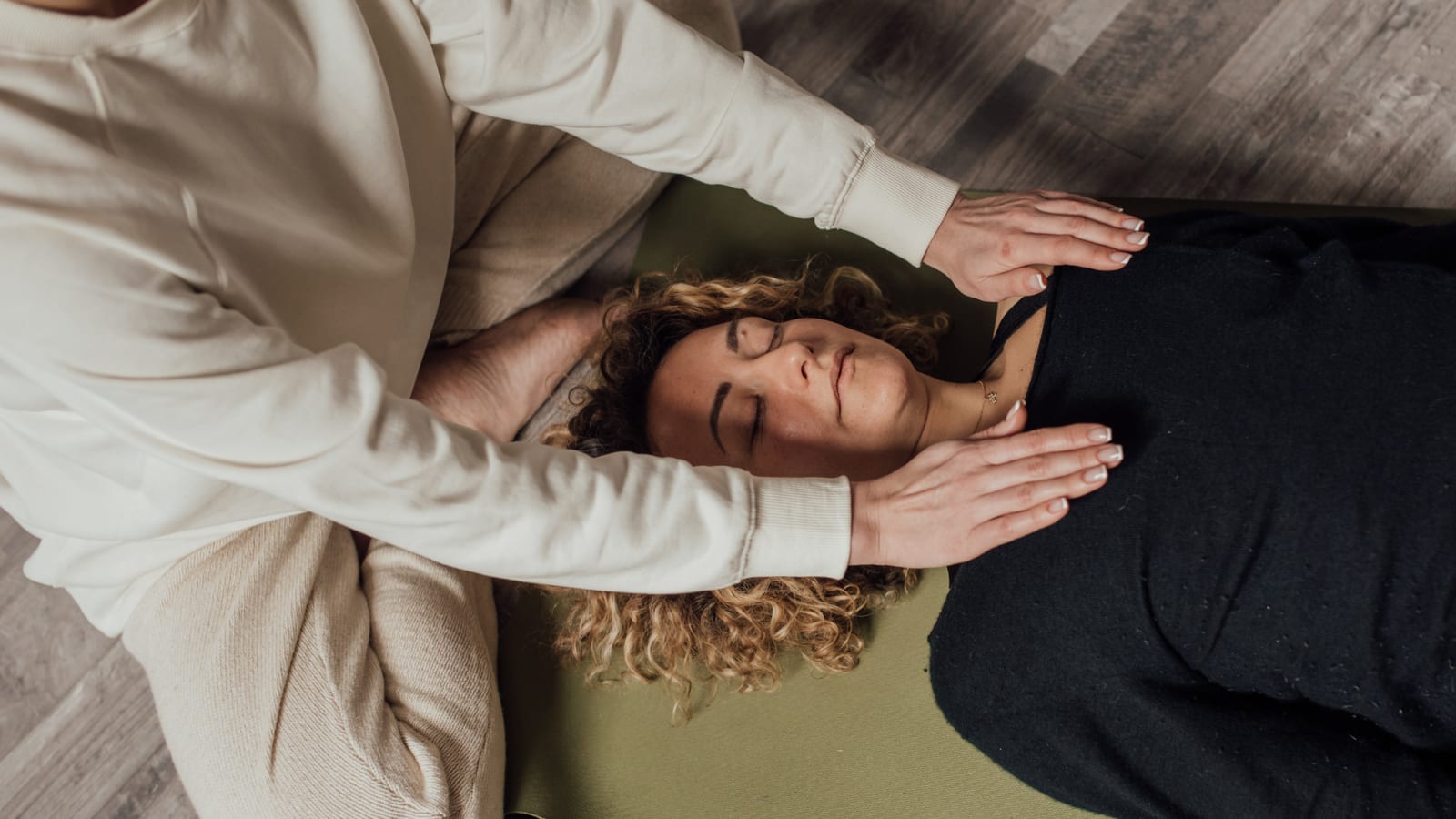
For seekers comparing modalities, sound healing pairs naturally with Reiki; both are non-touch energy practices, both rely on parasympathetic activation, and many practitioners are trained in both. If one resonates, the other often does.