8 minute readModality deep-divePublished May 6, 2026
Reiki is a specific Japanese practice with a specific founder, a specific technique, and an unbroken lineage. It is not generic energy work, and the difference matters.
On this page
Reiki is not what most people think it is.
It is not generic energy work. It is not a feeling. It is not an Instagram aesthetic. It is a specific Japanese practice with a specific founder, a specific technique, and a specific lineage that runs in an unbroken teacher-to-student line from the early twentieth century to today.
Mikao Usui developed it in 1922 on Mount Kurama in Japan. Everything else in the modern Western Reiki landscape, the books, the chairs, the YouTube tutorials, the weekend certifications, descends from that one moment. The practice has been carried, faithfully and unfaithfully, through three and a half generations of teachers since.
This piece is for the seeker who wants to understand what Reiki actually is before deciding whether to receive it, and how to tell a real practitioner from one who simply uses the word.
Where Reiki actually comes from
Mikao Usui (1865–1926) was a Japanese Buddhist with a long-standing interest in healing practices. The story, as preserved by the lineage, is that he undertook a twenty-one-day fasting retreat on Mount Kurama in 1922, after which he reported a transmission of the practice that he then refined and taught. The original Japanese society he founded, the Usui Reiki Ryōhō Gakkai, still exists in Japan and remains a members-only organisation.
The Western lineage runs through three names. Usui taught Chujiro Hayashi, a former Japanese naval officer and physician, who systematised the hand positions and treatment forms that most Western Reiki students learn today. Hayashi taught Hawayo Takata, a Japanese-American who travelled to Japan from Hawaii in the 1930s, received treatment for a serious illness, trained with Hayashi, and brought the practice back to Hawaii in 1937. Every Western Reiki teacher alive today traces their lineage through Takata.
Mikao Usui (1865–1926) → Chujiro Hayashi (1880–1940) → Hawayo Takata (1900–1980) → twenty-two Western Master teachers initiated by Takata → contemporary lineage holders. The unbroken line is the credential.
The word Reiki itself, written 霊気, predates Usui's system. It means spiritual energy or atmosphere of the spirit, and in classical Japanese it could describe a felt quality in a place or person. Usui's contribution was not the word. His contribution was the practice that bears it.
What actually happens in a session
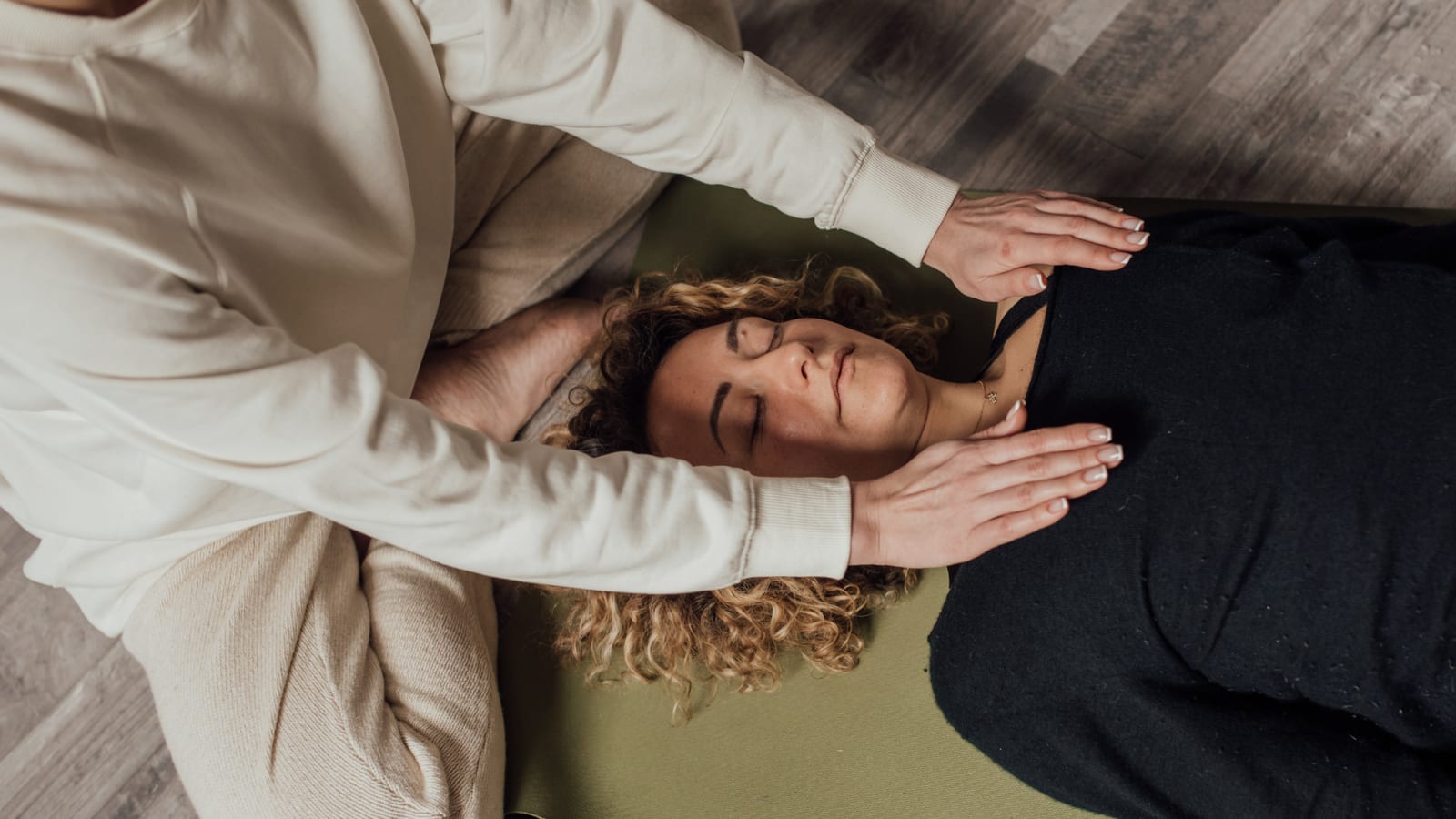
A first session typically runs ninety minutes. The recipient lies fully clothed on a flat treatment table, sometimes under a light blanket. The practitioner takes a few minutes to settle, often pauses at the head of the table for a moment, and then begins a sequence of hand positions, usually starting at the head and moving down the body, then continuing to the feet, then sometimes returning to specific locations.
The hands either hover a few inches above the body or rest lightly without pressure. There is no kneading, no joint manipulation, no needles, no oils. Most practitioners work in silence; some use very quiet music, often single-instrument or ambient.
What does the recipient feel? Different things, sometimes nothing at all. Common reports include warmth in specific areas, tingling, a sensation of weight or lightness, occasional emotional release, and a soft drift into the state between waking and sleep. Some clients sleep through the second half of the session and wake up rested. Others remain alert throughout. The session is considered to "work" regardless of what the recipient consciously notices.
A session usually ends with a few minutes of quiet integration, a glass of water, and a brief debrief. Most practitioners offer notes or observations. The good ones do not over-interpret what they felt during the session, and they do not promise outcomes they cannot deliver.
What Reiki is, and what it isn't
Reiki is a structured Japanese energy practice with formal attunements (called reiju in Japanese), three traditional degrees (Shoden, Okuden, Shinpiden in Japanese; First Degree, Second Degree, Master in the Western branch), and a clear lineage requirement. Real practitioners can name their teacher and their teacher's teacher; the chain is the credential.
Reiki is not a substitute for medical care. It is not a treatment for cancer, autoimmune disease, infection, or any other condition that medicine treats well. A Reiki practitioner who suggests otherwise is either undertrained or unethical, and in either case the right move is to leave.
Reiki is not a substitute for trauma therapy. The practice is sometimes recommended to people processing significant trauma, and it can support that work, but it does not replace it. Somatic therapy, with a properly trained somatic therapist, is the modality that addresses trauma directly. A serious Reiki practitioner who senses that a client needs trauma work will refer.
Reiki is not a generic word for any energy practice. The misuse of the term is the single biggest source of confusion in the wellness landscape. If someone tells you they "do Reiki" and cannot name their teacher, what they offer may be valuable, but it is not Reiki in any meaningful sense.
What does the evidence say
This is the honest part.
Self-reported outcomes from Reiki sessions are reasonably consistent: reductions in anxiety, reductions in self-reported pain, improvements in sleep, a sense of softening or release. Several clinical studies, including some inside hospital systems, have measured these effects in patient populations and found them durable enough to be worth offering as adjunctive care.
The mechanism is where the honest debate lives. The "biofield" hypothesis, that practitioners are channelling or directing a measurable form of subtle energy, has not been reproducibly demonstrated under blinded conditions. What can be demonstrated is that the recipient's autonomic nervous system shifts toward parasympathetic dominance during a session: heart rate slows, respiration deepens, cortisol drops. Whether this is "energy" or "the calming effect of an attentive presence in a quiet room for ninety minutes" is exactly the question that the research has not yet resolved.
The conclusion most reasonable observers land on, and the one we hold, is that something is happening. The question is whether it is energy transfer, parasympathetic activation from a calm, attentive presence, placebo, or some combination. The honest answer is that we do not fully know.
There is a real difference between we don't fully understand it and it doesn't work.
That difference matters. The first is an open scientific question. The second is a dismissal. The Reiki tradition deserves the first reading, and the seekers we work with consistently report that it earns it.
Choosing a Reiki practitioner
The first question is the lineage question. Ask, "who was your Reiki teacher, and who was their teacher?" A real practitioner will answer specifically and quickly. A practitioner who hesitates, or whose answer is vague, has not been properly trained.
The second question is training format. In-person attunements are the standard. Distance attunements exist within the tradition and have a long internal debate, but online weekend certifications generally do not produce skilled practitioners. The hours of practice between attunement and seeing clients matter; ask how many sessions the practitioner has logged, and whether they trained under supervision.
Avoid practitioners who claim Reiki cures specific medical conditions. Avoid practitioners who pressure expensive multi-session packages on a first visit. Avoid practitioners who layer mystical claims onto every session debrief; the work tends to speak more quietly than that. Avoid anyone who tells you to discontinue medical care or therapy.
The broader question of how to vet practitioners across modalities is the subject of our piece on what spiritual concierge actually means, and the framework there applies here directly.
Reiki and sound healing are often offered together, and many practitioners are trained in both. Both are non-touch modalities, both work on parasympathetic activation, and both reward a settled environment more than they reward technique. If one resonates, the other usually does too.
What to expect over time
A single session can be calming and useful. A short series, three or four sessions, gives both you and the practitioner enough exposure to read patterns and notice what is and isn't moving. Some clients become regular long-term recipients (monthly, seasonally, or during specific life passages); others find one or two sessions sufficient and move on.
What changes over time, in clients who stay with the practice, is rarely dramatic. The shifts tend to be small and structural: better sleep, less reactivity, easier rest, a quiet sense of returning to oneself. The practice is not heroic. It is steady. That is part of why it has lasted a hundred years on the Western branch and considerably longer in Japan.
A serious practitioner will not promise transformation. They will offer the practice, hold the room, and let the practice do what it does. That is the work. That is also the credential.
Questions, gently answered
Read next
Modality deep-dive
Plant medicine integration: the work that makes the ceremony matter
9 minute read
Modality deep-dive
Hypnotherapy, demystified: clinical practice past the stage hypnosis cliché
9 minute read
Modality deep-dive
Sound healing, demystified: ancient practice, modern science, and Instagram
9 minute read
